
Punishment or Discipline? Our take
This page describes the use of discipline rather than punishment and why it is the best way to raise a competent and happy child.
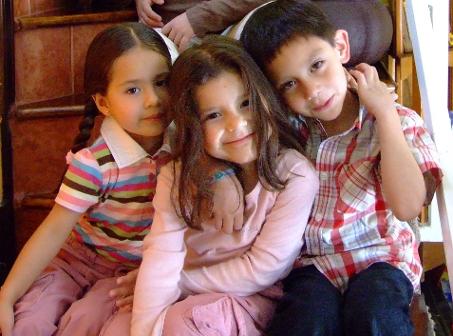
(photo from Morguefile.com)
Part One
Most of us grew up with punishment as the model of discipline used to control and modify our behavior. Spankings, confiscated toys, getting grounded and having privileges taken away are all punishments that are familiar to most. Many parents might say "Hey, it worked! Look at me, I'm fine!". In most cases, the passing of years has dimmed the resentment, anger and hurt that these forms of punishment created at the time, and while we may have turned out "fine", it could well be that our childhoods and our lives, as well as the crucial relationship with our parents, might have been better and produced even better and stronger versions of us as adults.

The first element of our focus here that is different than many parenting philosophies involves a deep respect for the child and for childhood in general as a crucial learning period in a person's life. Babies come to us with zero self-discipline. They holler when they are in need, they squirm, grasp, screech, wet their diapers, shove food into their mouths with greasy little fingers, pull hair, bite, kick and wail when they don't get what they want. This is natural and totally to be expected... they're babies! Babies do all of these things because they have not matured to a point where it makes sense for them to moderate their behavior yet. Everything they do is meant to elicit constant and vigilant care and protection by the parents.
As a child grows, it is their job to gradually learn to control their behavior so that they can focus on wider goals than simply encouraging care-taking from their parents. A child needs to be able put their focus on immediate wants and needs aside so that they can learn, interact with others and mature into intelligent, happy and effective older children and adults. Our job as parents is to help them to do this.
(part two below!)

(photo from MorgueFile.com)
These are some favorite parenting books.
The first three of them are by Faber and Mazlish, and are recommended as basic parenting guides. These are:
- How To Talk So Kids Will Listen and Listen So Kids Will Talk
- Siblings Without Rivalry
- How to Talk So Teens Will Listen and Listen So Teens Will Talk
Part Two
We are agreed that our job as parents is to help our children to grow into happy and successful adults, correct? Then why do so many parents develop an adversarial relationship with their children? An "us against them" stance is so common between parents and children, and this is the wrong way to reach our goals as parents. We must remember that we are partners in a joint effort between parent and child, the focus of which is our stated goal - a happy and successful adult. Both parent and child are working toward this goal together. Both want the happy and successful adult to be the outcome. So when you find yourself feeling like you're working against your child, stop and think it through. Re-align your thinking and change your approach so that you feel that you are on your child's side, not competing with him.
If you can achieve this mindset, you will easily see how discipline rather than punishment is the preferred method of behavior modification. Punishment is retaliatory, it is vindictive, it is arbitrary and, most of all, it undermines the "team" of parent and child working together towards that common goal. Punishment is for dogs and felons, discipline is for children.
I will be offering examples of exact dialogues. Some will be "invented" by me and some will be composite, de-identified clients I worked with in therapy. About half my clients were children, but as every therapist knows, the real client is the parent, because the parent has much more influence on a child than a once a week therapy session for an hour. If the parent can be coached to use more appropriate disciplinary methods, all will be good with the child.
So what is discipline then, and how does it differ from punishment?
------------------------------------------------------------------------
Following is an example of challenging discipline for a three year old boy. On the left is what actually happened in the store. On the right, the better way to handle the incident. You'll notice the difference right away.

Previous Page: Home Next Page: Chatting Porch